
- Guest Article
What a House Remembers
- By Pam Kovalewski
Joy is something I receive as a gift, everyday I assist seniors and their families through a difficult process. One that can be extremely overwhelming and stressful on the adult children. Those who take on extreme responsibilities to ensure their parents wishes are being followed and that they are in good hands.We’ve been so blessed and privileged to work with the daughter of a recent senior in distress. Overwhelmed with a daunting task of living in an adjoining State and trying to take care of a parent from hours away. Faced with a huge home chocked full of so many memories, losses and difficult decisions ahead. Siblings who were unable to help. Working so hard to make things right. Stuck with the task of cleaning out her mother’s home after sitting for 2 years. Seeing the stress melt …in front of my eyes… when she found out we could take care of absolutely everything she needed to do, but was so overwhelmed she couldn’t even start.A young woman whose heart thought of us first, when she filled a fridge and counter with snacks and beverages for our team on start day. Who told us regularly how much she appreciated us and what we were doing for her. So completely understanding and patient with the giant task ahead of us. She is a beautiful soul, a wonderful daughter, and I wanted to share her very special story. . .
* * *
What a House Remembers
By Rachel Brittin
This might be the last time I visit my parents’ house. It’s what I say to myself every time I have stopped by in recent weeks. When I walk through, my footsteps sound different than they used to. No televisions play in another room, no dishes are being put away, and no laughter or voices call from upstairs. Without furniture, rugs, pictures, or people, every sound travels farther. The rooms echo in more ways than one.
The house was built in 1905. They bought it in 1989, and for 37 years it was their home, and I still called it home long after I moved away. Thirty-seven years is a long time in the life of a family. It is enough time for children to grow up, for parents to grow older, for grandkids to be born, for holidays to accumulate, for routines to become traditions, and for traditions to become memories. Yet in the life of a house that has stood for 120 years, it is only one chapter.
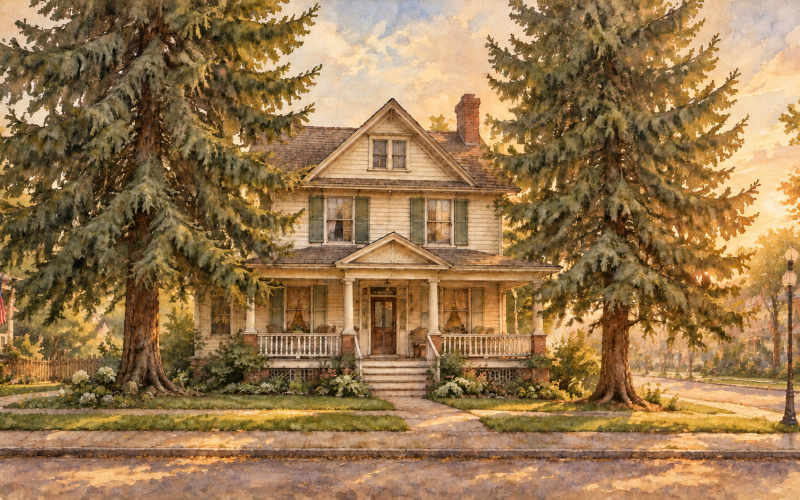
Long before any of us arrived in Lemoyne, other families crossed these floors. They opened these same doors, looked through these windows at versions of the same street, and climbed the stairs after long days. The house shows us its old secrets every now and then. Last month, a painter found five layers of wallpaper in the dining room, each pasted over the last. He called to excitedly tell me he found gold wallpaper with pink rose accents behind an old radiator. Someone chose each pattern. Someone stood back and decided that this was how the room should look. Years passed, tastes changed, another family came along, and a new pattern covered the old one. Beneath the walls, we knew there were other versions of the same room, hidden but never entirely gone.
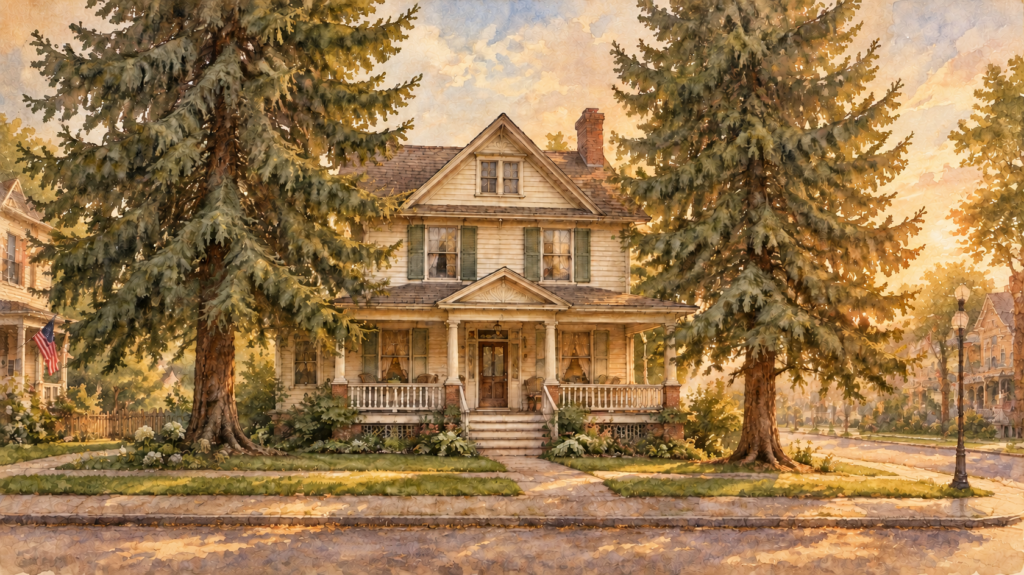
Outside, two enormous Norway spruces rise over the front yard. They were planted by the porch when the house was built as “husband and wife trees,” a pair meant to grow together. A Victorian-era tradition that the trees outgrew long ago. Today they still tower over the house, older and larger than anyone who ever lived there. Recent storms have battered them, breaking branches and leaving scars, but they are still standing. Something about that is comforting.
In 1989, the house became the backdrop to our family’s life, and it was never silent or bare. Old videos remind me of the joy inside. Music filled the rooms. At Christmas, piano notes drifted through the house. Other days, it might be Paul Simon or Jethro Tull, music in the atmosphere of home. The walls and shelves were full, too. My stepdad was an artist, and his work was everywhere. Art lined the walls and filled the shelves until creativity itself seemed woven into the fabric of this place. It was all evidence of a life being made here.
There were ordinary days, of course, the ones that seemed too unimportant to remember at the time. Meals in front of the TV, while presidents announced wars and Star Trek: The Next Generation transported us to a different time. Conversations passed from one room to another. Holidays, visitors, music, laughter, and little dogs barking. The repetitive habits of family life, now precious after they are gone.
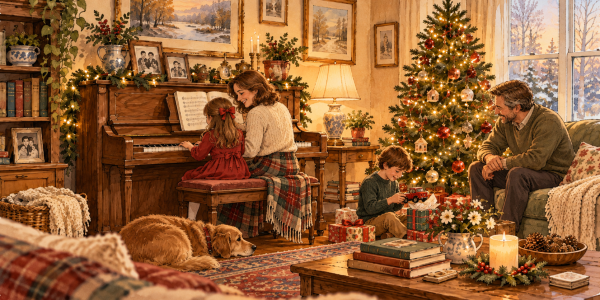
The house held the hardest days, too. The day my stepdad died from cancer, we gathered there. It’s been five years, and I still think about it when I walk through the empty rooms. A house once full of his artwork, music, and warm presence became the place where we came together in his absence. The walls that had contained so much of his life held us through the first hours of his death. For two years after he died, his jackets still hung by the front door, hats by the kitchen. Sketchbooks piled by his spot on the couch.
Perhaps that is what houses do best. They ask nothing of us. They simply remain. They are there when we bring babies home and also when someone does not come home again. They witness the 13th birthdays and the diagnoses, the arguments and reconciliations, the parakeets chirping in a cage, Christmas morning’s twinkling lights, and the hard phone calls that divide a life into before and after.
My mother lived much of her life in this house, but now she lives in a nursing home. At 75, she is deep in the grip of Alzheimer’s. Of all the losses that come with that terrible disease, there is one I keep returning to: so much of the life that happened here in this house is gone for her now. The music. The holidays. The artwork on the walls. The people gathered around the table. The version of herself who knew exactly where everything belonged and could walk through the rooms without thinking. It seems cruel that a person can spend decades building a life in a place and then lose access to it so quickly.
The house remembers in a way she can’t anymore. Not literally, of course. A house cannot tell a story. It cannot call up a Thanksgiving afternoon or describe the sound of someone’s laugh, but the evidence remains. A doorway opens into a room where something happened. A wall once held a painting. A worn floor records thousands of footsteps without knowing whose they were. Perhaps that is why the emptiness feels so strange now.
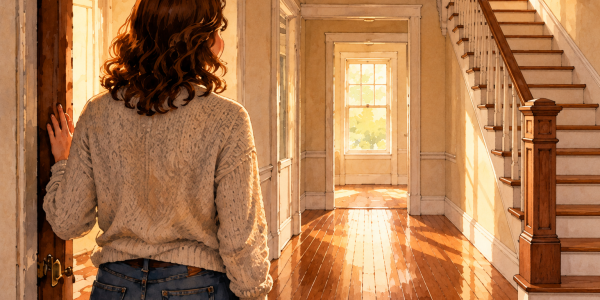
The artwork is gone. The shelves are bare. The music has stopped. The cat that snoozed on the piano is gone, the dogs barking at squirrels have stopped. Without the photographs, houseplants, books, and life that once defined the rooms, it feels as though the evidence disappeared, as though all those years happened somewhere else. But they didn’t. We were here. My stepdad was here. My mother was here.
For 37 years, this house held our family, and now, in a strange way, it holds some of what we can no longer hold ourselves. The walls have new paint, but they still stand as witnesses. The trees are still rooted in the front yard. The rooms of this house remain even when the people who filled them have died, grown up, forgotten, or moved away. That may be what a house teaches us if we stay long enough to listen: belonging was never the same thing as permanence.
Soon someone new will walk through the front door and imagine a future with their family instead of remembering a past. They may paint the walls new colors I would never choose. They may pull out cabinets, change the garden, or rearrange rooms whose purposes once seemed fixed. Perhaps someday they will peel back wallpaper, find a golden, shiny layer underneath, and wonder who chose it. A child may race down the hallway again. Someone may make pancakes on a Sunday morning. Friends and family may crowd around a dining room table or tell jokes in the kitchen. There will be new arguments, new puppies, new celebrations, new losses, new music, new ordinary Tuesdays.
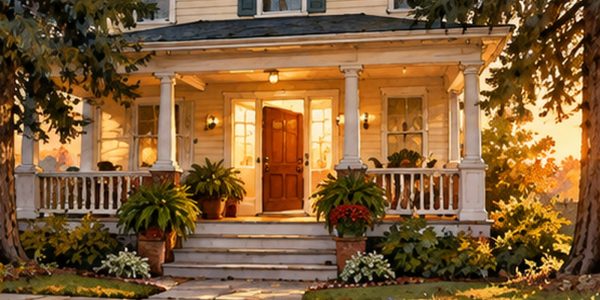
Outside, the husband-and-wife trees will keep watch, changed by time but still reaching over the house. For those of us leaving this place behind, moving on feels like another loss. But perhaps for the house, it is something else. Perhaps it is simply another layer. The empty halls are waiting for the next voices, the next footsteps, the next songs, the next people who will fill the rooms without yet understanding how quickly a life inside them can become memory. Maybe that is why letting go of a house is so difficult. We are not really grieving the wood and plaster. We are grieving the life that happened inside the house now standing as a quiet monument.
* * *
At Complete Senior Transitions, our mission has always been to educate, empower, and protect seniors.
Knowledge and planning are the strongest safeguards we can offer.
You can also find free educational content through our Smart Seniors radio show, available on our Media page.
“Youth is a gift of nature, but age is a work of art.”
Related Posts
Serving Seniors Throughout South Central Pennsylvania
Complete Senior Transitions supports seniors in Adams, Cumberland, Dauphin, Franklin, Lancaster, Lebanon, Perry, York, and neighboring Maryland counties.
Downsizing, real estate, moving, and estate cleanout services — all in one place.

Ready to Take the Next Step?
We’re here to help you move forward with confidence.
📞 Call us today at 717-502-2507
✉️ Or schedule your free consult using our Contact Form
🔗 Google Business Listing